
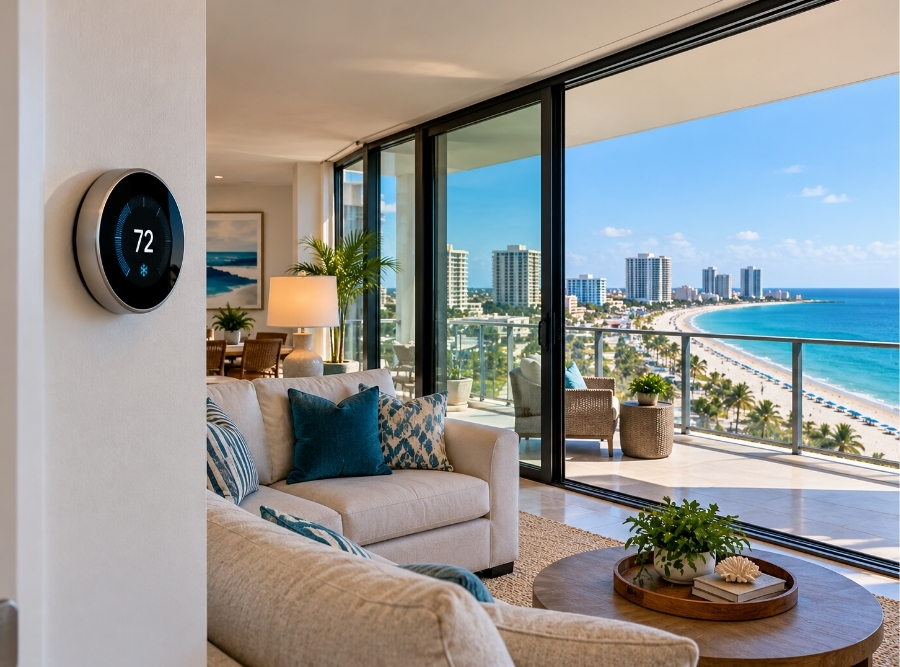
Can Smart Home Technology Be Added to a Clearwater Beach Condo Without Violating Association Rules?
Quick Answer:
Yes, smart home technology can be added to a Clearwater Beach condo without violating association rules, as long as the work stays inside the unit, preserves the building’s fire-rated doors and master key access, and matches the unit’s HVAC system. Anything that touches common elements, plumbing or entry hardware should have written association approval before installation.
Clearwater Beach condo towers were built for ocean views and hurricane resilience, not for consumer smart devices. Many of the high-rises along the Gulf and the Intracoastal Waterway date from the 1970s through the 1990s. They were designed with fan coil air handlers, master-keyed entry locks, steel fire-rated doors and thick concrete floors. A thermostat, lock or doorbell that installs easily in a single-family home can run into all of those at once. The result is often a violation notice, a failed air conditioner or a lock that won’t throw.
That doesn’t mean a beach condo has to stay low-tech. Many owners want keyless entry for rental guests, remote climate control while they’re away, and a way to catch a leak before it reaches the unit below. Those are all achievable. The difference is designing around how the building actually works and getting the association’s approval in the right way.
What Clearwater Beach Condo Associations Typically Regulate
Condo associations regulate the parts of the building that affect everyone. That usually includes common elements such as corridors and exterior walls, limited common elements like balconies and entry areas assigned to one unit, and anything that changes how the building looks from shared spaces. Many Clearwater Beach towers also have architectural uniformity policies that require every entry door along a corridor to match. A video doorbell or keypad on the hallway side of the door can violate that rule even if it never touches the unit’s interior.
Beach towers add a few concerns that suburban associations rarely deal with. Entry doors are usually fire-rated assemblies governed by fire codes, and associations are responsible for keeping those assemblies intact. Many buildings use master-keyed lock cylinders so staff and emergency personnel can enter a unit during a leak or medical emergency. Florida law also gives condo associations a right of access to units for maintenance and emergencies, which is why a lock that shuts staff out can become a serious issue.
Rental rules matter too. Many Clearwater Beach associations regulate short-term rentals through approval or registration requirements. Unapproved modifications can put that authorization at risk. For an owner who depends on rental income, a doorbell violation can cost far more than the doorbell ever did. Reading the declaration, rules and rental policies before planning any technology is the most valuable first step.
The Misconception: Building Maintenance Approval Means Association Approval
A common assumption among beach condo owners is that if the building maintenance person installs a device, or says it’s fine, the association has approved it. In most buildings, that isn’t how approval works. Maintenance staff handle repairs and upkeep, but modifications to doors, common elements and building systems usually require written approval from the board or its architectural committee. An informal okay in the hallway rarely protects an owner when a violation notice arrives later.
This matters most for entry hardware. Owners sometimes ask maintenance staff to swap in a consumer smart lock, and the original commercial handle and cylinder end up in a closet or thrown out. If the association later requires the original hardware, the owner may have to pay for replacement master-keyed cylinders. In some cases, the association hires its own contractor to restore the door and bills the owner at emergency rates. Keeping every original component and getting approval in writing prevents both problems.
A formal request also tends to go more smoothly than owners expect. Boards are generally more comfortable approving a device when they can see exactly what it is, how it attaches and how the door or system can be restored. A written plan that shows the device, the mounting method and how master key and fire code requirements are preserved answers most of their questions before they ask.
Fan Coil Units, Heat Pumps and the Thermostat Problem
Thermostats cause some of the most expensive smart home mistakes in Clearwater Beach condos. Many older towers don’t use the central split systems common in single-family homes. Instead, units have fan coil units served by the building’s chilled water system, or water-source heat pumps connected to a shared building water loop. Some fan coil systems use line-voltage controls at 120 or 240 volts. Wiring a standard low-voltage smart thermostat to those controls can burn out the thermostat, the transformer or the unit’s control board instantly.
| HVAC type | How owners usually recognize it | Thermostat approach |
|---|---|---|
| Fan coil unit on building chilled water | Air handler in a closet with water pipes, often no outdoor condenser for the unit | Thermostats or relay kits designed for fan coil and multi-speed fan control |
| Water-source heat pump | Unit heat pump tied to a building water loop | Confirm control voltage and compatibility before choosing a device |
| Standard split system | Outdoor condenser on a balcony or roof | Most smart thermostats work, with a proper C-wire |
Even low-voltage systems can cause trouble. Fan coil units often use multi-speed fan controls that many consumer thermostats don’t support. Power-stealing adapters can create brownouts on control boards. Some air handlers are also tucked into closets where the breaker isn’t obvious, so owners work on wiring that is still live.
The consequences go beyond a warm unit. A failed air conditioner in a closed beach condo can let indoor humidity climb quickly. Incorrect wiring can also disable the overflow switch that shuts the system down when the condensate drain backs up. In a high-rise, that failure can send water into the unit below. Confirming the HVAC type and control voltage before buying a thermostat avoids all of it.
Master Keys, Fire Doors and Keyless Entry
Most Clearwater Beach towers depend on master-keyed lock cylinders so building staff and first responders can reach any unit in an emergency. A smart lock that replaces the cylinder removes that access. If a pipe bursts or an owner has a medical emergency while the unit is locked with a device staff can’t open, the delay can be costly and dangerous. That is why many associations restrict lock replacements more tightly than any other upgrade.
Fire-rated entry doors add a second constraint. The door, frame and hardware are certified to work together under fire codes. Drilling a steel fire door or installing an unrated lock can void that certification. Commercial steel frames also tend to reject residential smart deadbolts. The bolt drags against the strike, the motor grinds, and the lock eventually fails to secure the door at all.
The workable options preserve both requirements. Retrofit smart lock modules that attach to the interior side of the existing deadbolt keep the original cylinder and its master key in place. They also add keyless control from inside. Some buildings allow specific approved smart locks that are rated for their door assemblies and compatible with their master key systems. Others offer access control integrations for the building as a whole. Whichever path applies, the lock should be fitted to the frame so it throws cleanly, and the association should approve the hardware in writing.
Leak Shutoff and Humidity Control for Owners Who Are Away
A leak is the most expensive thing that can happen to an unoccupied Clearwater Beach condo, largely because it rarely stays in one unit. A failed supply line under a sink or a clogged air handler drain can run for days before anyone notices. By then, water has reached the ceilings and walls below. For snowbirds and absentee owners, a smart leak detection and shutoff system is often the most valuable upgrade they can make.
These systems pair water sensors near fixtures and the air handler with a motorized shutoff valve on the unit’s water supply. When a sensor detects water, the valve closes automatically, and the owner gets an alert. Because plumbing in a condo may involve common elements up to the unit’s own valve, the installation should be done by a licensed plumber and approved by the association. The system should also preserve the association’s emergency access, so staff can still respond if something goes wrong.
Humidity control belongs in the same plan. Beachfront units left closed with the air conditioning set high can see humidity rise quickly, and mold can follow within days. Keeping indoor humidity below about 60 percent is a common guideline for preventing mold. A compatible smart thermostat with humidity monitoring lets owners watch conditions remotely and adjust before a problem starts. It also warns them if the air conditioning stops running entirely.
Keyless Access for Short-Term Rentals
Short-term rental owners on Clearwater Beach often want keyless entry more than any other feature. Handing off physical keys between guests is inconvenient, and lost keys create security problems. Unique digital codes for each stay solve both issues. The challenge is providing them without breaking the building’s master key system or its rules on entry hardware.
Interior retrofit locks are usually the answer here as well. They keep the original cylinder and master key in place while adding code-based entry that can be managed remotely. Codes can be created for each guest’s stay and expire automatically at checkout. Separate codes for cleaners and maintenance vendors can also be tracked individually. Rental turnover puts heavy wear on lock mechanisms, so the hardware should be rated for frequent use and checked periodically.
Access management matters as much as the lock itself. Over several rental seasons, codes and app permissions pile up, and a unit can end up with dozens of old guest and vendor credentials still active. A well-designed system makes it easy to review and remove access regularly. For owners who manage from out of state, remote code management and battery alerts are essential. They keep a guest from being locked out at 10 p.m. with no one nearby to help.
Why Beach Towers Challenge Wireless and Exterior Devices
Clearwater Beach high-rises are often built with post-tensioned concrete, which is strong and hurricane-resistant but difficult for wireless signals. Concrete and rebar absorb and reflect Wi-Fi, Zigbee and Z-Wave signals, so a lock near the entry may struggle to reach a router at the far end of the unit. Metal-stud interior walls make it worse. The fix is usually a properly placed access point or smart home hub near the devices that need it, not a more powerful router.
Post-tensioned concrete also carries a serious warning. These floors and some walls contain steel tendons under very high tension. Drilling into them without scanning first can cut a tendon, which is dangerous and expensive to repair. Any installation that involves drilling into concrete should be approved by the association and preceded by proper scanning. In most cases, wireless and surface-mounted solutions avoid the need entirely.
Exterior devices face the climate on top of everything else. Many towers have open or semi-enclosed breezeways, where salt mist from the Gulf corrodes keypad contacts and battery terminals quickly. Adhesive mounts soften and fail in the heat and humidity. Devices that must sit outside the unit should be approved, rated for coastal exposure and attached with the association’s preferred method, never with tape on shared walls.
What Getting It Wrong Costs
| Stage | What usually happens | Relative cost |
|---|---|---|
| Approved, compatible install | Interior lock retrofits, compatible thermostat controls and approved leak protection | Predictable service cost |
| After a violation | Emergency reinstallation of original hardware, repairs to door damage and clearing the violation | Moderate to high |
| Worst case | Replacing a fire-rated entry door and covering water damage to neighboring units | Highest |
For rental owners, unresolved violations can also threaten rental authorization, which often outweighs the repair cost.
The Paradise Systems Difference
Most beach condo technology problems come from devices designed for single-family homes and installed without regard for how the tower works. Paradise Systems starts with the building. We identify the HVAC type and control voltage, check how the entry door and master key system are configured, review the association’s rules, and look at how concrete construction will affect wireless coverage. Only then do we recommend equipment.
That approach produces a system the association can approve and the owner can rely on from a distance. We favor interior lock retrofits that preserve master key access and thermostat solutions matched to fan coil and heat pump systems. We design networks that reach every room of a concrete unit, and we coordinate with licensed plumbers on leak shutoff valves. We also help owners prepare clear written plans for association approval, which makes the process faster and avoids surprises later.
For absentee owners and rental hosts, we build around remote reliability: humidity and leak alerts, managed guest codes and battery monitoring. That way, small problems are caught before they become expensive ones. We work with condo owners across Clearwater Beach, Sand Key, Clearwater and the rest of Tampa Bay, including seasonal residents who manage their units from out of state.
Frequently Asked Questions About Smart Technology in Clearwater Beach Condos
Why won’t my Nest thermostat work with my condo’s fan coil unit?
Many Clearwater Beach condos use fan coil units or water-source heat pumps instead of standard split systems. Some fan coil systems use line-voltage controls that consumer smart thermostats can’t connect to safely. Others use multi-speed fan controls that standard thermostats don’t support. A thermostat or relay kit designed for your specific system is usually required, so confirm the HVAC type and control voltage before buying.
Can I install a smart lock if my building uses a master key system?
Usually, as long as the lock doesn’t remove the building’s master-keyed cylinder. Interior retrofit locks attach to the inside of your existing deadbolt, which keeps the original cylinder and master key access intact. Some associations also approve specific smart locks that work with their master key systems and fire-rated doors. Always get written approval before changing entry hardware.
Can I add an automatic water shutoff valve to my Clearwater Beach condo?
In most buildings you can, and it’s one of the most valuable upgrades for owners who are away for long periods. Because plumbing may involve common elements, the valve should be installed by a licensed plumber with association approval. The system pairs leak sensors with a motorized valve that closes when water is detected and alerts you by phone. It should be set up so building staff can still respond in an emergency.
How can I give rental guests keyless entry without violating association rules?
An interior retrofit smart lock lets you issue unique codes for each guest while keeping the original cylinder and master key in place. Codes can be scheduled to start at check-in and expire at checkout. Separate codes for cleaners and vendors let you track access individually. Check your association’s rental and hardware rules first, since some buildings approve only specific devices.
How do I prevent mold in my beach condo while I’m away?
Keep the air conditioning running at a sensible setting rather than turning it off, and aim to keep indoor humidity below about 60 percent. A compatible smart thermostat with humidity monitoring lets you watch conditions from anywhere and adjust as needed. It can also alert you if the system stops running entirely. Pairing it with leak sensors near the air handler catches drain backups before they cause damage.
Planning Smart Upgrades for Your Beach Condo
If you own a condo on Clearwater Beach or Sand Key and want keyless entry, remote climate control or leak protection, a planning visit before you buy equipment can save you fines, repairs and approval delays. We can identify what your building’s systems will support, prepare a clear plan for your association, and install technology that works reliably whether you’re in the unit or a thousand miles away. Paradise Systems is available to help beach condo owners across Clearwater and Tampa Bay upgrade the right way.