
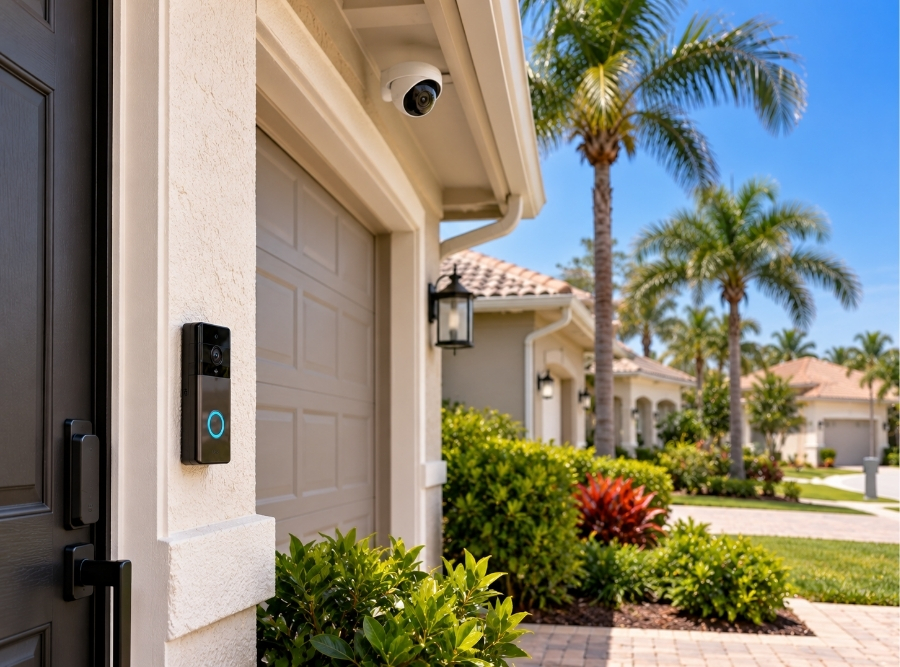
Do Sarasota and Lakewood Ranch HOA Communities Allow Exterior Smart Cameras or Video Doorbells?
Quick Answer:
Most Sarasota and Lakewood Ranch HOA communities allow exterior smart cameras and video doorbells, but usually only after architectural review approval and within rules on size, color, placement and wiring. Florida law doesn’t give homeowners a blanket right to install cameras over HOA objections. Cameras also need to avoid recording audio and avoid looking into neighbors’ private spaces.
Most camera disputes in Sarasota’s deed-restricted communities start the same way. A homeowner in Lakewood Ranch mounts a bright white camera above the garage after a package theft, without filing any paperwork. A few weeks later, a violation notice arrives from the management company, and a neighbor mentions feeling watched while using the pool. The homeowner only wanted to protect the driveway. The problem was the approach: an unapproved device, visible wiring and a field of view nobody thought through.
Getting camera coverage right in an HOA community is less about finding a loophole and more about planning. Architectural review committees generally approve cameras that look like they belong on the house, are installed cleanly and respect the neighbors. Homeowners who treat the application as part of the project usually get the coverage they want without fines, hearings or strained relationships next door.
What Sarasota and Lakewood Ranch HOAs Usually Regulate
Master-planned communities across Lakewood Ranch, Palmer Ranch and other deed-restricted neighborhoods typically route exterior changes through an Architectural Review Committee or Design Review Board. Cameras and video doorbells usually fall under those rules because they change how the home looks from the street. The committee’s focus is generally appearance and neighborhood impact, not whether a homeowner should have security at all.
| What the ARC reviews | Typical concern | Compliant approach |
|---|---|---|
| Camera size and style | Large domes and pan-tilt cameras look commercial | Low-profile mini cameras or discreet turrets |
| Color and finish | Bright white or black devices stand out on stucco | Colors that match trim or are paintable |
| Wiring | Exposed cable on exterior walls | Wiring hidden in soffits or paintable conduit |
| Mounting location | Shared villa walls, common fences or fascia | Mounting only on surfaces the owner controls |
| Lighting | Floodlights triggered by palms and passing cars | Aimed lighting with motion zones tuned to the property |
Location matters as much as appearance. In villa and paired-home communities, a wall that seems like part of your house may be shared or maintained by the association. A camera mounted there can become a common-element issue. Floodlight cameras cause their own complaints, because constant triggering from wind-blown palm fronds can turn into a nuisance violation. Reading the community’s guidelines before choosing equipment avoids most of these problems.
The Misconception: Florida Law Protects My Right to Any Camera
Many homeowners believe Florida law guarantees them the right to install any security camera they want, regardless of HOA rules. That isn’t how it generally works. Florida has passed specific protections for some homeowner choices over the years. Security cameras are not generally among the items state law shields from association control. HOAs in Florida can typically require approval and regulate how cameras look and where they go, as long as they follow their governing documents.
That doesn’t mean associations can do anything they want. Rules have to be adopted and enforced according to the community’s documents and the procedures in Florida’s HOA statute. Homeowners are entitled to proper notice and a hearing before fines are imposed. Fines can accumulate, sometimes daily for a continuing violation, up to the limits set by state law and the community’s documents. If a board adopts a new rule and applies it to a camera that was approved years earlier, that is worth questioning.
Disputes over fines, enforcement or whether a rule is valid are legal questions, and they should go to an attorney familiar with Florida community association law. For most homeowners, though, the practical path is simpler. Assume the ARC has authority over appearance and placement, design a system that meets its standards, and submit an application before installing. That approach avoids fines and usually gets the camera approved.
Privacy Law: Audio Recording and Neighbors’ Private Spaces
The most serious risk with exterior cameras isn’t the HOA. It’s audio. Florida is an all-party consent state for recording private conversations, which generally means everyone in a conversation must consent before it is recorded where people reasonably expect privacy. Many smart cameras and video doorbells record audio automatically. A doorbell that picks up a neighbor’s conversation on the side yard, or voices through an open window, can create legal exposure far more serious than an HOA fine.
The simplest protection is to turn audio recording off on any camera that could pick up conversations beyond your own property. Many homeowners keep audio only on the video doorbell for talking with visitors, and they disable it on cameras covering side yards, lanais facing neighbors and shared sidewalks. Checking these settings after every firmware update is worthwhile, since updates sometimes change defaults.
Video placement deserves the same care. Recording your own driveway, entry and yard is generally fine. Recording areas where neighbors reasonably expect privacy, such as the inside of their home, a bedroom window or an enclosed pool area, invites complaints and possible legal trouble. Privacy masking, a setting that blacks out selected parts of a camera’s view, lets a camera cover your property while excluding a neighbor’s windows or lanai. It is also one of the most persuasive details to include in an ARC application.
How to Get a Camera or Doorbell Approved
ARC applications move fastest when they answer the committee’s questions before the committee asks them. A strong application includes the manufacturer’s specification sheet for each device, with its dimensions and available colors. It also includes photos of the home marked with the exact mounting location of each camera. Committees respond well to clear visuals, because they can see precisely how the finished installation will look from the street.
The application should also explain how the installation will be done. That means describing how wiring will be concealed, whether through soffits, inside walls or in paintable conduit matched to the exterior. It means confirming that every device mounts on surfaces the homeowner owns and maintains, not on shared walls or common fences. Including screenshots or diagrams of each camera’s field of view, with privacy masks applied over neighbors’ windows and yards, shows the committee the neighbors have been considered.
Timing matters too. Submitting before buying equipment gives the homeowner room to adjust if the committee asks for a smaller camera, a different color or a new location. Owners who install first and apply later often end up paying twice: once for the original equipment and again for removal, repairs and replacement. A few weeks of patience at the start is usually the cheapest part of the project.
Low-Profile Installation That Still Protects the Home
A compliant camera system doesn’t have to be a weak one. Placement is where most of the difference is made. Cameras tucked under eaves or into soffit corners are less visible from the street and better protected from sun and rain. They can still cover driveways, entries and side yards effectively. Small wedge and corner mounts adjust the viewing angle so a camera sees the property without facing directly into a neighbor’s home.
Stucco requires careful installation. Every hole drilled through an exterior wall is a potential path for water during Sarasota’s summer downpours. Penetrations should be sealed properly, with cables routed so water drains away from the opening instead of following the wire inside. Poorly sealed holes can lead to hidden water damage in wall framing. Unapproved equipment ripped down after a violation often leaves unsealed holes behind.
Night vision needs attention as well. Infrared illuminators can reflect off light-colored stucco and create glare in the camera image. They can also cast light toward neighboring windows. Adjusting camera angles and motion zones reduces both problems. The same tuning keeps palm trees, passing cars and shared sidewalks from triggering constant alerts. Homeowners should resist disabling lighting or cameras entirely to satisfy a complaint, since that can leave driveways and entries dark. A better-designed installation usually solves both the complaint and the coverage.
Sarasota Conditions That Affect Camera Installations
Sarasota’s climate is hard on exterior equipment. Summer heat above 90°F and heavy humidity weaken adhesive mounts, and cameras attached with tape or light-duty brackets can drop onto driveways. Intense sun degrades plastic housings and unpainted mounts over time. Salt air near Siesta Key, Lido Key and the bayfront also corrodes mounting screws and outdoor network connectors faster than inland. Equipment chosen for these conditions lasts longer and looks better, which also keeps it compliant.
Lightning is a constant summer factor. Afternoon storms from June through September send surges through outdoor camera cables, and those surges can damage network video recorders, hubs and switch ports inside the home. Proper grounding and surge protection on exterior camera lines prevents one strike from taking out the entire system.
Community layout shapes camera design too. Neo-traditional Lakewood Ranch villages such as Central Park, Harmony and Bridgewater place homes close together, which makes aiming and privacy masking especially important. Homes backing onto preserves, lakes and golf courses need night coverage that watches for wildlife and trespassers without facing neighbors across the water. Seasonal residents across Sarasota’s gated communities often want remote monitoring while they’re away. For them, a system that is both reliable and fully compliant matters more than for anyone else.
What Getting It Wrong Costs
| Stage | What usually happens | Relative cost |
|---|---|---|
| Planned and approved | Low-profile cameras, concealed wiring and privacy masking submitted before installation | Low, with no fines |
| After a violation | Removal, stucco patching and painting, rerouted wiring and re-aimed cameras | Moderate |
| Worst case | Accumulated fines, legal fees and full replacement after an enforcement action | Highest |
The pattern is the same as most HOA issues. The earlier the planning happens, the less the project costs.
The Paradise Systems Difference
Most HOA camera problems come from equipment chosen for coverage alone, with no thought for how it looks, how it’s wired or what it sees next door. Paradise Systems designs exterior camera systems for all three at once. We start with the community’s guidelines, then choose cameras and mounting locations that give the homeowner real coverage and a clean, understated appearance.
We can help prepare the documentation an ARC typically wants to see, including specifications, marked-up photos of each mounting location, wiring plans and field-of-view diagrams with privacy masking applied. During installation, we conceal wiring inside soffits and walls wherever possible and seal every penetration in the stucco. We also configure audio and motion settings with Florida’s privacy considerations in mind. The result is a system that is easier to approve, less likely to draw complaints and built to last in Sarasota’s climate.
For homeowners who have already received a violation notice, we can remove noncompliant equipment and repair the surfaces it left behind. We can then design a replacement the committee is more likely to approve. We work with homeowners across Sarasota, Lakewood Ranch and the rest of Tampa Bay, including seasonal residents who depend on remote monitoring while they’re away.
Frequently Asked Questions About HOA Rules for Cameras and Video Doorbells
Can my HOA make me remove my Ring camera?
In many cases, yes, if the camera was installed without required approval or doesn’t meet the community’s architectural standards. Florida law generally allows HOAs to regulate the appearance and placement of exterior cameras through their governing documents. The usual path forward is to submit an application for approval, adjusting the camera’s size, color, location or wiring as needed. If you believe the rule or enforcement is improper, speak with an attorney who handles Florida community association law.
Is it illegal for my camera to see my neighbor’s pool or lanai?
A camera that incidentally captures part of a neighbor’s yard while covering your own property is generally a different matter from one aimed into a private space. Pointing a camera into a neighbor’s windows, bedroom or enclosed pool area invites complaints and possible legal trouble. Privacy masking lets you block those areas from the camera’s view while keeping coverage of your own property. Adjusting the angle is usually the fastest way to resolve a neighbor’s concern.
Should I turn off audio recording on my security cameras?
For most exterior cameras, yes. Florida generally requires consent from everyone in a private conversation before it is recorded. Cameras that pick up neighbors’ conversations can create legal exposure. Many homeowners keep audio only on a video doorbell for talking with visitors and disable it elsewhere. Check your settings after firmware updates, since defaults can change.
How do I hide camera wires on a stucco house?
The cleanest option is to route wiring through soffits, attics and interior walls so it never appears on the exterior. When that isn’t possible, paintable conduit matched to the stucco color keeps wiring discreet and usually satisfies architectural guidelines. Every hole through the stucco should be sealed carefully to keep out summer rain. Exposed cable is one of the most common reasons ARC applications are denied.
What should I do after receiving an HOA camera violation letter?
Read the notice carefully, note any deadlines, and review your community’s architectural guidelines. In many cases, the fastest resolution is to submit an application for an approvable version of the installation, or to correct the specific issue cited. Keep all communication in writing. If fines are being imposed or you believe the rule is being applied improperly, consult an attorney familiar with Florida community association law.
Planning Camera Coverage That Fits Your Community
If you’re considering exterior cameras or a video doorbell in a Sarasota or Lakewood Ranch HOA community, planning before you buy saves time, money and friction with your neighbors and your board. We can review your community’s guidelines, design coverage that protects your home, and help you prepare an application that answers the committee’s questions up front. If a violation notice has already arrived, we can help you correct it cleanly. Paradise Systems is available to help homeowners across Sarasota and Tampa Bay add security the right way.